Western Europe · Austria
Graz
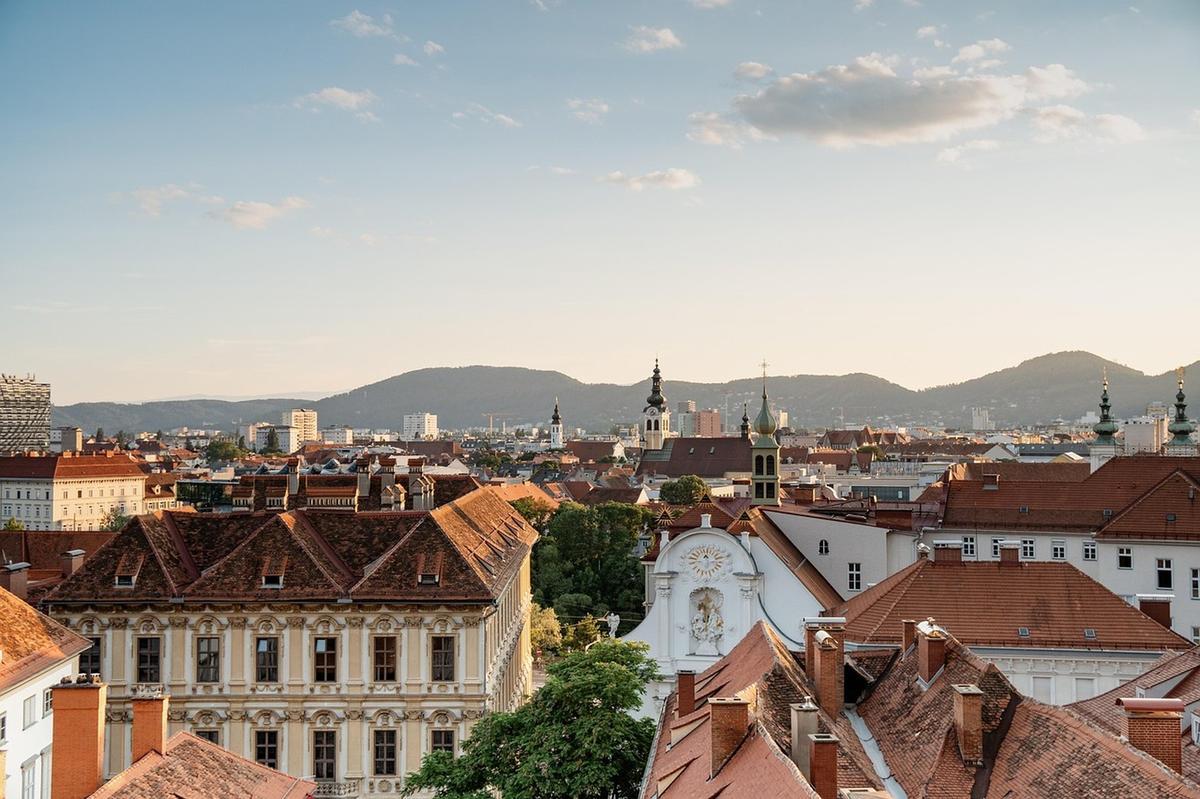
Austria's second city carved a life Vienna cannot offer: a medieval core intact enough to walk without irony, and a university culture filling every café.
Solo $3,896/mo · Couple $5,759/mo · Data as of November 2026
Our estimate: energy and cuisine · Methodology
raz sits at the foot of the eastern Alps in a Styrian basin, a mid-size Austrian city that delivers Western-European infrastructure without Vienna's premium. Its historic core, the Altstadt, is well preserved; an enormous student population keeps the pace lively without tipping into disorder. Healthcare is excellent, air is clean, and the language from market to clinic is German.
Graz suits remote workers who want Western-European infrastructure at a gentler cost than the capital—clean air, solid healthcare. Healthcare-focused retirees find a system that performs without complex insurance navigation. Academics drawn by the university ecosystem get genuine intellectual life without a capital price tag; families willing to enter German-language schooling find safety and a walkable historic core.
The international-school market is thin enough to be a hard stop for expat families with school-age children who will not integrate into German-language education, and the English that carries through the Altstadt and university districts retreats quickly once you leave them. For all its university-town energy, Graz keeps moderate hours—it winds down earlier than the student density suggests.
Find cities that fit you
A free quiz ranks all 343 cities against what matters to you.
Vibe and character
Graz runs at a pace that trusts itself—ordered streets, Styrian cooking heavy on good meat, evenings that begin in wine bars and rarely extend past midnight. Weekends push into the surrounding hills. The defining sensory note is not noise but cold air and timber.
Source: UNESCO · Methodology
City character
Our estimate: city character ratings · Methodology
Cost
$3,896 for a solo month — Graz sits in the broad middle of mid-size city pricing. The cost ladder within Graz is compressed: choosing a less central or smaller flat saves modestly but doesn't move the needle on monthly budget.
Source: Numbeo, collected November 2026, in our cost model · Methodology
These are recurring monthly costs. Moving itself — deposits, shipping, visas, flights, temporary accommodation — is not included, and it is usually the largest number in your first year. When grouped by region elsewhere on this site, North America covers the United States, Canada, and Mexico.
Monthly cost · by household
Priced for a Western-expat mid-range lifestyle — local-style living usually costs less.
All figures above are the Average lifestyle baseline for Graz — Western mid-range expat methodology, November 2026, line-by-line cost model. Want to model a different lifestyle? Use the widget below to swap household size, lifestyle tier, and quick toggles. It starts from the same Solo + Average baseline and diverges as you customize.
Run the full Cost Reality Check for Graz
Priced for your household and lifestyle tier, line by line. $79 one-time.
Where Graz sits globally
Lifestyle spending in Graz sits in the corpus's mid-range.
Safety and rights
On personal safety, Graz performs well — 73 out of 100 — with no district-level concentration of risk to navigate around.
Sources: Numbeo, collected November 2026 · ILGA World · Georgetown GIWPS, 2023/24 · Freedom House · Methodology
Climate
Graz carries a continental climate — summers that rarely turn hot, long cold winters, and a wide swing between the seasons. Seasons run on a continental rhythm — summer heat compressed into a few months around July, long winters with snow and sub-freezing weeks, transitions short and brisk. Average lows in January drop below -5°C, requiring real winter clothing and indoor-priority planning for the coldest months.
Sources: WMO / NOAA NCEI, normals 1991–2020, published 2023, checked Oct 2026 · ACAG SatPM2.5 (Washington University in St. Louis), 2021–2023 · Methodology
Our estimate: winter rating · Methodology
12-month temperature and rainfall
Hottest month is July with average highs of 26°C; wettest month is August with 126 mm of rainfall.
Sunshine hours: not available for this city
Season by season
Coolest months · Dec–Feb
The coolest stretch of the year — average highs around 3°C.
Hottest months · Jun–Aug
The warmest stretch of the year — average highs around 26°C.
Wettest months · Jun–Aug
The heaviest rainfall of the year — about 126 mm in the wettest month.
Healthcare
Excellent healthcare is the baseline in Graz — coverage is universal, with private options as supplement rather than substitute. English-language care is available in the larger private facilities, and care is organised through the country's health system.
Source: international insurers, 2024 · Methodology
Our estimate: healthcare quality and English-medium care · Methodology
Healthcare costs are reasonable by developed-world standards — basic local insurance at $152 a month, with international-portable cover available at a premium.
Graz's public health system runs on universal coverage — citizens and registered residents are covered regardless of income. Most expats rely on the public system after registration — private medicine is supplementary rather than essential, used for specific specialists or elective speed. Premiums for portable global cover sit well below US private-market levels, though the local universal system means most residents don't need it.
Systems, insurance and prescription rules are set nationally, not city by city. How healthcare abroad actually works
The quiz weights healthcare quality against your other priorities — climate, cost, language — to show where Graz stands. Get the full ranking · $99
Practical
Graz's mobility is solid — with one or two parts sitting below the top tier. Graz's transit network is thin — bus and limited rail coverage means most residents rely on cars or ride-hail for everyday movement. Walking works for most daily needs — solid sidewalks, density, and district connectivity support walking as a primary mode. Graz's tap water is safe to drink — a practical convenience and a marker of broader water infrastructure quality.
Sources: OpenStreetMap contributors · EF EPI · Methodology
Our estimate: visa and admin, Western digital services · Methodology
Language
German is the main language, though English proficiency in Graz sits in the Very High band — language barriers are minimal across daily life. English handles every category of daily life in Graz — institutional, commercial, and conversational — without need for local-language ability. German is worth learning for integration on multi-year stays, though the operational gap from English alone is small.
Mobility and connectivity
Walking is the primary mode in Graz's central districts — at walkability 73, pedestrian infrastructure supports most daily needs. Public transport in Graz is constrained — limited rail and a thin bus network make transit useful for certain routes but inadequate as the primary mode. Ride-hail in Graz is priced high — $21 per typical trip, with frequent use costing meaningfully more than equivalent transit or vehicle alternatives.
Transit scores count only transit with its own dedicated right-of-way — metro, elevated and underground rail, trams on dedicated lines, and fully separated busways (BRT). Buses and trams sharing regular car lanes don’t count, however frequent.
Visa pathways and admin ratings shown here are for the principal applicant — spouse and dependant work rights vary by pathway; check the linked official source before relying on them.
Minority faith infrastructure
Mosques — moderate · Buddhist temples — few.
We record mosques, synagogues, Buddhist temples and Hindu temples — the ones hardest to assume from a country's majority religion — and show whichever are present here. Christian places of worship are not recorded; in most of the corpus they are the default rather than the question.
The quiz weights admin complexity against your situation to show where Graz stands. Get the full ranking · $99
Schools
International schooling in Graz is functional but thin — 3 schools cover the demand, with one offering an IB programme, with curriculum variety and capacity both narrower than in larger expat markets. International tuition runs $5,545 a year on average — comfortably below US or Western European private-school pricing, with the typical case in the low-to-mid band across the cities we cover.
Our estimate: school counts · Methodology
Tuition: Estimated — no published price found.
International schooling in Graz is limited — 3 schools cover the basics, with most families targeting specific curriculum continuity finding narrower options than in larger European capitals. Graz has 3 international-curriculum schools, with one offering an IB programme, so curriculum variety is limited. Graz's tuition runs $5,545 a year on average — well below Western private-school pricing, with both premium and mid-market options accessible to typical expat budgets.
Graz's bilingual sector sits below the international layer — German-English schools at meaningfully cheaper tuition than the international tier, often a sensible compromise for longer stays. Most family relocation profiles work in Graz, though families targeting specific Anglosphere or Continental-European curricula through secondary should verify availability before committing.
The quiz weights school availability against your other priorities — climate, cost, language, healthcare — to rank Graz against other cities with comparable school depth. Compare the free and full quiz
Sources
- Numbeo, collected November 2026, in our cost model: monthly costs, cost rank
- WMO / NOAA NCEI, normals 1991–2020, published 2023, checked Oct 2026: climate type and temperatures, muggy months
- Numbeo, collected November 2026: safety index
- Freedom House: political freedom
- EF EPI: English proficiency
- UNESCO: World Heritage sites
- ILGA World: LGBTQ+ rights
- Georgetown GIWPS, 2023/24: women’s safety
- ACAG SatPM2.5 (Washington University in St. Louis), 2021–2023: air quality
- international insurers, 2024: health insurance
- OpenStreetMap contributors: walk and transit scores
Data last reviewed October 2026
The Graz decision pack.
Includes Find My City (every city that clears your non-negotiables, ranked) and the Cost Reality Check for Graz. One-time payment.
Find cities that fit you
A free quiz ranks all 343 cities against what matters to you.