South America · Ecuador
Quito
Quito balances a perpetual spring against a safety profile that varies sharply by neighbourhood—a calculus that settles into habit.
Solo $1,983/mo · Couple $2,911/mo · Data as of November 2026
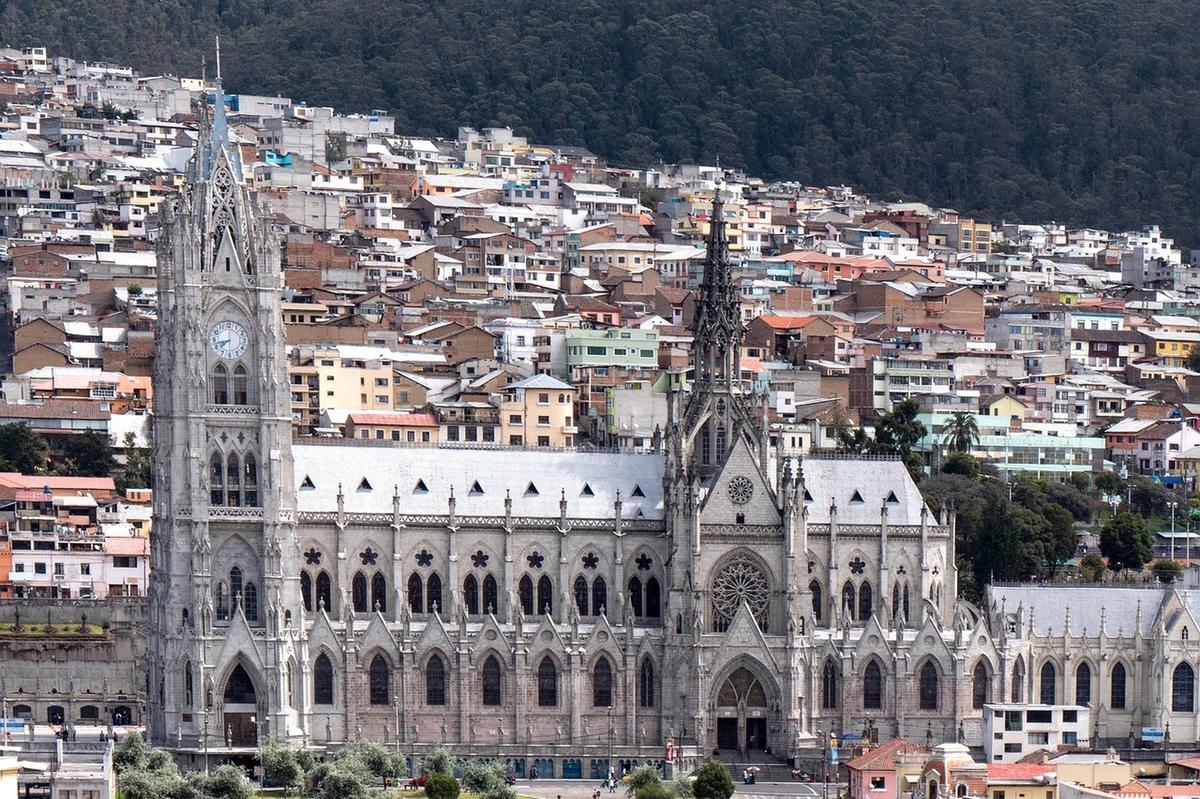
Our estimate: energy and cuisine · Methodology
uito sits in a high Andean valley on volcanic slopes, a geography that delivers a mild, spring-like climate year-round rather than equatorial heat. Affordable by South American capital standards, with healthcare that outperforms regional expectations and a workable international-school market. Spanish is the operating language; English reaches moderate coverage in the centre.
Quito draws remote workers who want an Andean base with a cool climate and a cost that leaves savings intact, families who need a workable international-school market without paying European fees, and healthcare-focused relocators who find regional standards are reasonable here. Anyone with a genuine interest in Andean cuisine—complex, spiced, distinctive—will find the food scene earns its reputation.
The safety profile is the thing that most complicates daily life here: it varies enough by neighbourhood that new arrivals spend real time mapping where they will and won't go after dark. Walkability is poor across most districts; tap water is not safe to drink untreated; and civic freedoms, while formally present, are only partially and unevenly protected.
Find cities that fit you
A free quiz ranks all 343 cities against what matters to you.
Vibe and character
The city pulses at a lively pace well into the evening, with a cuisine that is spiced and memorably textured. Weekends here tend outward—to the cloud forest, the coast, or the Amazonian foothills—a circuit of escapes that gives the city its rhythm.
Source: UNESCO · Methodology
City character
Our estimate: city character ratings · Methodology
Cost
$1,983 for a solo month places Quito in the lower band of large-city cost — well below Western European or US equivalents. Rental prices vary moderately across Quito — a real but bounded cost difference between central and outer districts.
Source: Numbeo, collected November 2026, in our cost model · Methodology
These are recurring monthly costs. Moving itself — deposits, shipping, visas, flights, temporary accommodation — is not included, and it is usually the largest number in your first year. When grouped by region elsewhere on this site, North America covers the United States, Canada, and Mexico.
Monthly cost · by household
Priced for a Western-expat mid-range lifestyle — local-style living usually costs less.
All figures above are the Average lifestyle baseline for Quito — Western mid-range expat methodology, November 2026, line-by-line cost model. Want to model a different lifestyle? Use the widget below to swap household size, lifestyle tier, and quick toggles. It starts from the same Solo + Average baseline and diverges as you customize.
Run the full Cost Reality Check for Quito
Priced for your household and lifestyle tier, line by line. $79 one-time.
Where Quito sits globally
Among the cheaper cities in the corpus by household budget.
Safety and rights
Personal safety scores very low — 37 out of 100 — with sharp district-to-district variation: some neighbourhoods read safely, others materially raise daily exposure. Politically, the picture is partial: Freedom House classifies Ecuador 'Partly Free', though civil-status law is recorded as legal by ILGA.
Sources: Numbeo, collected November 2026 · ILGA World · Georgetown GIWPS, 2023/24 · Freedom House · Methodology
Climate
Quito runs temperate — mild winters, gentle summers, and no season that turns cold or hot. Rainfall peaks in April, at around 171mm, with the seasons shading into one another rather than turning abruptly.
Sources: INAMHI, normals 1981–2010, checked Oct 2026 · Copernicus Climate Change Service (ERA5), dataset cited 2023, means for 1991–2020, checked Oct 2026 · ACAG SatPM2.5 (Washington University in St. Louis), 2021–2023 · Methodology
Our estimate: winter rating · Methodology
12-month temperature and rainfall
September is the hottest month at 22°C average highs; April brings the year's heaviest rainfall at 171 mm.
Sunshine hours: not available for this city
Season by season
Coolest months · Feb–Apr
The coolest stretch of the year — average highs around 21°C.
Hottest months · Aug–Oct
The warmest stretch of the year — average highs around 22°C.
Wettest months · Mar · Apr · Oct
The heaviest rainfall of the year — about 171 mm in the wettest month.
Healthcare
Healthcare in Quito reads as good — solid for everyday medicine, with specialist depth varying by facility. English in clinical settings is functional but inconsistent, and access runs through the country's health system.
Source: international insurers, 2024 · Methodology
Our estimate: healthcare quality and English-medium care · Methodology
Costs run moderate — insurance at $152 a month and out-of-pocket pricing below Western private rates.
Public healthcare in Quito runs on a national scheme covering Ecuador citizens; expats have access on a fee basis but in practice rely primarily on the private system. Expats typically use the private system for routine care and elective procedures — the public sector serves citizens and the broader population, with quality variable by facility. International-portable cover with global access is widely available and well-priced — typically a fraction of comparable US plans, with the affordability making it standard among long-stayers.
Systems, insurance and prescription rules are set nationally, not city by city. How healthcare abroad actually works
The quiz weights healthcare quality against your other priorities — climate, cost, language — to show where Quito stands. Get the full ranking · $99
Practical
Getting around Quito on foot or by transit sits below the corpus's stronger cities — daily trips need workarounds rather than happening effortlessly. Quito's transit network is thin — bus and limited rail coverage means most residents rely on cars or ride-hail for everyday movement. Quito's walkability is limited — distances, traffic, and separation between districts constrain pedestrian use. Tap water is not routinely drunk straight — most households rely on bottled or filtered supply.
Sources: OpenStreetMap contributors · EF EPI · Methodology
Our estimate: visa and admin, Western digital services · Methodology
Language
Spanish is Quito's main language and EF places the country in the Low band on English — daily life requires either local-language ability or routing through expat-facing channels. In practice, English is functional in central expat districts, hotels, hospitals, and most private-sector services, and thins quickly in purely Spanish-residential neighbourhoods. Learning a working level of Spanish pays back disproportionately, particularly on stays running into multiple years.
Mobility and connectivity
Quito's walkability is limited — a walkability estimate of 35 reflects an urban form built around vehicles, with pedestrian infrastructure varying sharply by neighbourhood. Public transport in Quito is constrained — limited rail and a thin bus network make transit useful for certain routes but inadequate as the primary mode. At $6 per typical trip, ride-hailing in Quito runs cheap relative to Western markets and supports use as a default rather than emergency mode.
Transit scores count only transit with its own dedicated right-of-way — metro, elevated and underground rail, trams on dedicated lines, and fully separated busways (BRT). Buses and trams sharing regular car lanes don’t count, however frequent.
Visa pathways and admin ratings shown here are for the principal applicant — spouse and dependant work rights vary by pathway; check the linked official source before relying on them.
Minority faith infrastructure
Mosques — few.
We record mosques, synagogues, Buddhist temples and Hindu temples — the ones hardest to assume from a country's majority religion — and show whichever are present here. Christian places of worship are not recorded; in most of the corpus they are the default rather than the question.
The quiz weights admin complexity against your situation to show where Quito stands. Get the full ranking · $99
Schools
International schooling in Quito is well-developed — 33 schools run international curricula, of which 33 carry an IB programme, with the constraint at the premium end being enrollment timing rather than absence of options. Quito's international tuition averages $8,134 a year.
Our estimate: school counts · Methodology
Tuition: Estimated — no published price found.
Quito's international-school market is one of the deeper in South America — 33 schools serve the expat community at solid capacity. The 33 international-curriculum schools in Quito span British, American, IB, and a broader range of Continental-European and Asian curricula, of which 33 carry an IB programme, with substantial capacity at the established institutions. International tuition averages $8,134 a year — the price band sits below most Western expat-hub equivalents, with the spread wide enough to accommodate most family budgets.
Quito's bilingual sector sits below the international layer — Spanish-English schools at meaningfully cheaper tuition than the international tier, often a sensible compromise for longer stays. Family relocation to Quito works for essentially any profile — the choice is between price tier, curriculum specificity, and neighbourhood, with capacity meaningful across the market.
The quiz weights school availability against your other priorities — climate, cost, language, healthcare — to rank Quito against other cities with comparable school depth. Compare the free and full quiz
Sources
- Numbeo, collected November 2026, in our cost model: monthly costs, cost rank
- INAMHI, normals 1981–2010, checked Oct 2026: climate type and temperatures
- Numbeo, collected November 2026: safety index
- Freedom House: political freedom
- EF EPI: English proficiency
- UNESCO: World Heritage sites
- ILGA World: LGBTQ+ rights
- Georgetown GIWPS, 2023/24: women’s safety
- Copernicus Climate Change Service (ERA5), dataset cited 2023, means for 1991–2020, checked Oct 2026: muggy months
- ACAG SatPM2.5 (Washington University in St. Louis), 2021–2023: air quality
- international insurers, 2024: health insurance
- OpenStreetMap contributors: walk and transit scores
Data last reviewed October 2026
The Quito decision pack.
Includes Find My City (every city that clears your non-negotiables, ranked) and the Cost Reality Check for Quito. One-time payment.
Similar to Quito


Our estimate: food and weekend chips · Methodology
Find cities that fit you
A free quiz ranks all 343 cities against what matters to you.