Eastern Europe · Croatia
Split
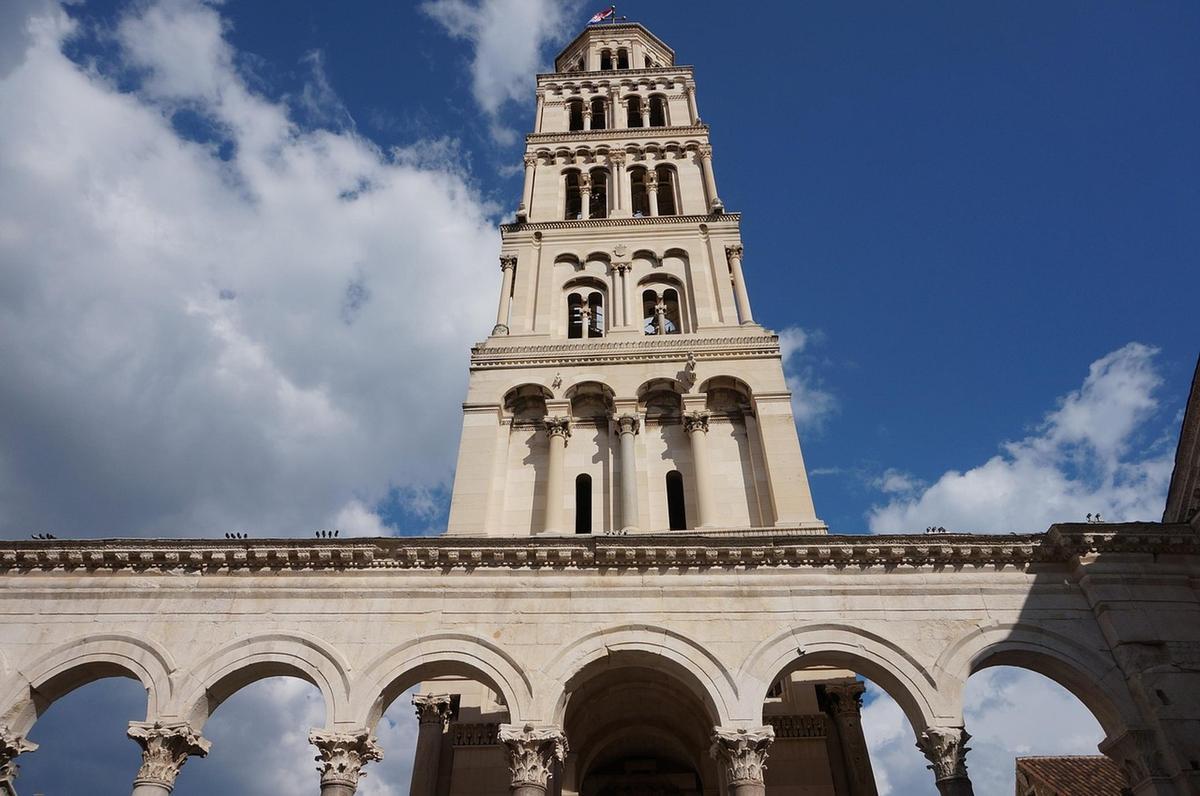
A city that grew up inside an emperor's retirement palace, trading marble corridors for laundry lines and espresso bars.
Solo $3,344/mo · Couple $4,771/mo · Data as of November 2026
Our estimate: energy and cuisine · Methodology
plit sits on the Adriatic in Dalmatia, a Mediterranean-climate city of modest proportions that stays reasonably priced by Western-European standards. Croatian is the native tongue, though English moves through the tourist economy without friction. Healthcare is solid; the international-school market is thin; the winters run mild; the air is clean.
Suits the remote worker drawn to Mediterranean rhythm without the price tags that follow it, the healthcare-focused retiree who values clean air and a walkable historic core, and the food-driven traveller content to eat at a konoba table well after dark.
Transit outside the old town is weak, making a car necessary for anyone living beyond the peninsula. The international-school options are limited and include no IB programme—a constraint for families on international curricula. The seasonal tourist surge that floods Diocletian's Palace through the summer months can make the city's most distinctive quarter feel more managed exhibition than living neighbourhood.
Find cities that fit you
A free quiz ranks all 343 cities against what matters to you.
Vibe and character
Split takes dinner seriously and evenings loosely—the waterfront promenade fills after dark, fish comes grilled and unhurried, and the surrounding islands offer an easy weekend reset. The energy is animated without the relentless edge of a major capital; the pace softens toward the sea.
Source: UNESCO · Methodology
City character
Our estimate: city character ratings · Methodology
Cost
$3,344 for a solo month — Split runs at the median of smaller-city cost across the cities we cover. Rental prices vary moderately across Split — a real but bounded cost difference between central and outer districts.
Source: Numbeo, collected November 2026, in our cost model · Methodology
These are recurring monthly costs. Moving itself — deposits, shipping, visas, flights, temporary accommodation — is not included, and it is usually the largest number in your first year. When grouped by region elsewhere on this site, North America covers the United States, Canada, and Mexico.
Monthly cost · by household
Priced for a Western-expat mid-range lifestyle — local-style living usually costs less.
All figures above are the Average lifestyle baseline for Split — Western mid-range expat methodology, November 2026, line-by-line cost model. Want to model a different lifestyle? Use the widget below to swap household size, lifestyle tier, and quick toggles. It starts from the same Solo + Average baseline and diverges as you customize.
Run the full Cost Reality Check for Split
Priced for your household and lifestyle tier, line by line. $79 one-time.
Where Split sits globally
Mid-band across the cities we cover on cost-of-living.
Safety and rights
Split scores 70 on personal safety — high — with risk concentrated in opportunistic petty crime rather than violent or systemic patterns.
Sources: Numbeo, collected November 2026 · ILGA World · Georgetown GIWPS, 2023/24 · Freedom House · Methodology
Climate
The climate is hot-summer Mediterranean — dry warm summers stretching from late spring to early autumn, mild winters that bring the year's rain. Summer peaks around July, November brings the most rain, and the transitions between seasons are brief.
Sources: WMO / NOAA NCEI, normals 1991–2020, published 2023, checked Oct 2026 · Copernicus Climate Change Service (ERA5), dataset cited 2023, means for 1991–2020, checked Oct 2026 · ACAG SatPM2.5 (Washington University in St. Louis), 2021–2023 · Methodology
Our estimate: winter rating · Methodology
12-month temperature and rainfall
July delivers the year's hottest average highs at 31°C; November the wettest at 120 mm.
Season by season
Coolest months · Dec–Feb
The coolest stretch of the year — average highs around 11°C.
Hottest months · Jun–Aug
The warmest stretch of the year — average highs around 31°C.
Wettest months · Sep · Nov · Dec
The heaviest rainfall of the year — about 120 mm in the wettest month.
Healthcare
Healthcare quality in Split is good across the everyday range — the better facilities set the standard, and quality is less uniform below them. English in clinical settings is good though not universal, and the country's health system sets how care is organised.
Source: international insurers, 2024 · Methodology
Our estimate: healthcare quality and English-medium care · Methodology
Healthcare costs are mid-band — local insurance at $152 a month, with procedure pricing below US private-market rates though above the cheapest emerging markets.
Universal public coverage is the foundation in Split — accessible to citizens and long-stay residents alike. Expats typically default to the public system once residency is established, with private cover for elective procedures and routes around elective queues. Premiums for international-grade insurance with global portability remain well below comparable US schemes — often a quarter or less of the equivalent — though for residents the public-private mix usually obviates the need.
Systems, insurance and prescription rules are set nationally, not city by city. How healthcare abroad actually works
The quiz weights healthcare quality against your other priorities — climate, cost, language — to show where Split stands. Get the full ranking · $99
Practical
Split's mobility is solid — with one or two parts sitting below the top tier. Public transit is very limited — the city is built around cars and ride-hail rather than transit. Split's walkability is mixed — central areas walkable, outer districts less so.
Sources: OpenStreetMap contributors · EF EPI · Methodology
Our estimate: visa and admin, Western digital services · Methodology
Language
Croatian is the main language of Split, but the EF English Proficiency Index places the country in the Very High band — English handles essentially all expat interactions. In practice, language barriers are minimal in Split — English carries essentially every interaction the average expat encounters. Picking up Croatian matters for community integration but not for daily logistics — English alone is functionally complete.
Mobility and connectivity
At walkability 60, Split is walkable in the centre and car-dependent at the edges — the mode mix shifts by district. Public transit is functionally limited in Split — the network covers a narrow set of routes, and daily mobility defaults to ride-hail or private vehicle. At $9 per typical trip, ride-hailing in Split is workable but not negligible — usage patterns trend toward planning around it rather than defaulting to it.
Transit scores count only transit with its own dedicated right-of-way — metro, elevated and underground rail, trams on dedicated lines, and fully separated busways (BRT). Buses and trams sharing regular car lanes don’t count, however frequent.
Visa pathways and admin ratings shown here are for the principal applicant — spouse and dependant work rights vary by pathway; check the linked official source before relying on them.
Minority faith infrastructure
Mosques — few.
We record mosques, synagogues, Buddhist temples and Hindu temples — the ones hardest to assume from a country's majority religion — and show whichever are present here. Christian places of worship are not recorded; in most of the corpus they are the default rather than the question.
The quiz weights admin complexity against your situation to show where Split stands. Get the full ranking · $99
Schools
International schooling in Split is thin — 5 schools run international curricula, with curriculum choice constrained and capacity tight at the higher end. International tuition runs $13,198 a year on average — mid-band for the corpus, with the spread wide enough to accommodate budgets from established-elite to mid-market alternatives.
Our estimate: school counts · Methodology
Tuition: Estimated — no published price found.
Split's international-school market is small — 5 schools serve expat families, predominantly British- and American-style with limited Continental-curriculum diversity. Curriculum variety is narrow in Split, with 5 international schools. Tuition runs $13,198 a year on average — sits in the broad middle of global expat-school pricing, with premium institutions well above and mid-tier alternatives below.
Beneath the international tier sit fragmented options — state schools and a thin private sector, with quality varying widely and limited curriculum continuity at the lower tiers. Most family profiles find a workable fit in Split, but families needing specific curriculum continuity — particularly IB Diploma or French baccalaureate completion through year 12 — should map provider availability against grade level before relocation.
The quiz weights school availability against your other priorities — climate, cost, language, healthcare — to rank Split against other cities with comparable school depth. Compare the free and full quiz
Sources
- Numbeo, collected November 2026, in our cost model: monthly costs, cost rank
- WMO / NOAA NCEI, normals 1991–2020, published 2023, checked Oct 2026: climate type and temperatures
- Numbeo, collected November 2026: safety index
- Freedom House: political freedom
- EF EPI: English proficiency
- UNESCO: World Heritage sites
- ILGA World: LGBTQ+ rights
- Georgetown GIWPS, 2023/24: women’s safety
- Copernicus Climate Change Service (ERA5), dataset cited 2023, means for 1991–2020, checked Oct 2026: muggy months
- ACAG SatPM2.5 (Washington University in St. Louis), 2021–2023: air quality
- international insurers, 2024: health insurance
- OpenStreetMap contributors: walk and transit scores
Data last reviewed October 2026
The Split decision pack.
Includes Find My City (every city that clears your non-negotiables, ranked) and the Cost Reality Check for Split. One-time payment.
Similar to Split


Our estimate: food and weekend chips · Methodology
Find cities that fit you
A free quiz ranks all 343 cities against what matters to you.