Southeast Asia · Indonesia
Yogyakarta
The sultan still governs, the students define the economy, and Yogyakarta remains one of Java's most unexpectedly affordable keepers of Javanese refinement.
Solo $979/mo · Couple $1,474/mo · Data as of November 2026
Our estimate: energy and cuisine · Methodology
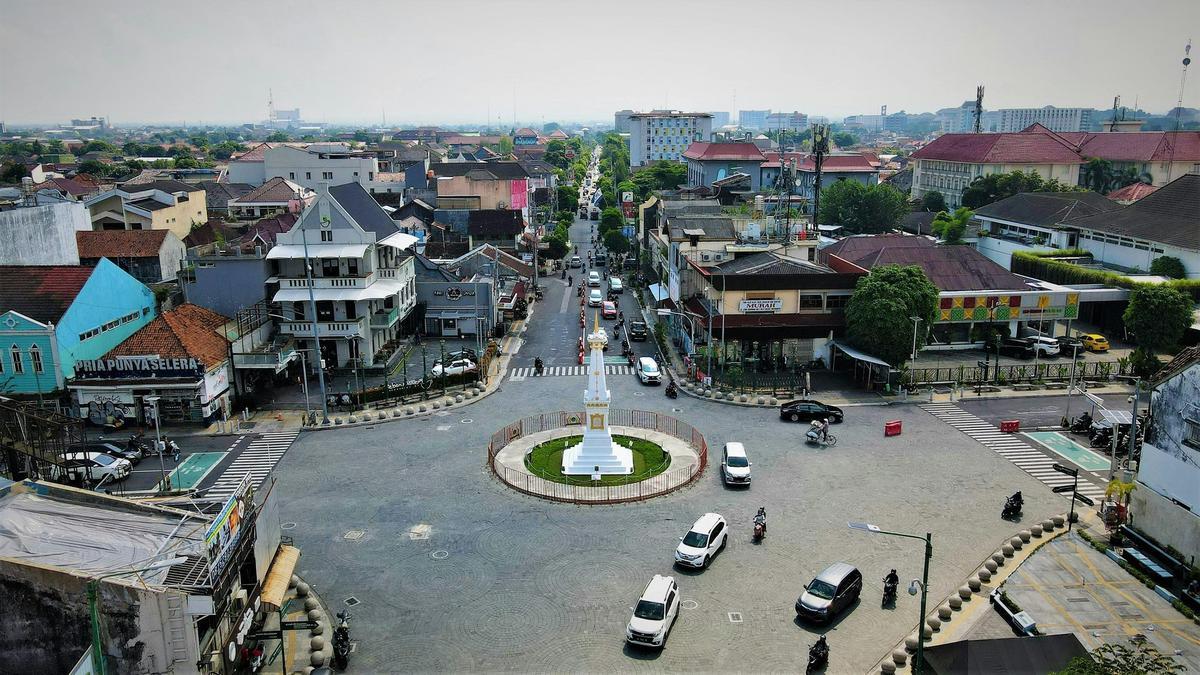
ogyakarta spreads across Java's south-central plain in the shadow of an active volcano, a permanently warm and very humid city that costs remarkably little by almost any external benchmark. English functions in the university districts and around the old centre; the international-school market is shallow, with only a handful of options; healthcare is adequate.
Yogyakarta rewards budget-conscious remote workers for whom low rent and a distinctive food culture outweigh infrastructure deficits. Food-driven travellers find Javanese cooking—spiced, layered, specific to this corner of Java—at its most concentrated. The arts draw a quieter crowd: batik, wayang, and gamelan practised here at serious craft level.
Without a car or motorcycle-taxi app, covering ground becomes effortful—both transit and walkability are thin. Tap water is not safe to drink. Civic freedoms are unevenly protected, and same-sex relationships face legal restriction that residents need to factor into daily life; the humidity, relentless year-round, is its own separate reckoning.
Find cities that fit you
A free quiz ranks all 343 cities against what matters to you.
Vibe and character
Yogyakarta runs warm and textured through every season—gamelan drifting from palace courtyards, late-afternoon traffic coiled around batik stalls, the air carrying clove smoke and something floral. The pace is lively without capital urgency. Weekends open easily to volcanic highlands or the ancient temple grounds ringing the plain.
Source: UNESCO · Methodology
City character
Our estimate: city character ratings · Methodology
Cost
Yogyakarta sits at the bottom of the cost ladder for large cities — $979 solo, an unusual value for the urban infrastructure on offer. The cost ladder within Yogyakarta has the expected shape — prime areas command a premium over outer districts, though not at the extremes seen in cities with very high inequality.
Source: Numbeo, collected November 2026, in our cost model · Methodology
These are recurring monthly costs. Moving itself — deposits, shipping, visas, flights, temporary accommodation — is not included, and it is usually the largest number in your first year. When grouped by region elsewhere on this site, North America covers the United States, Canada, and Mexico.
Monthly cost · by household
Priced for a Western-expat mid-range lifestyle — local-style living usually costs less.
All figures above are the Average lifestyle baseline for Yogyakarta — Western mid-range expat methodology, November 2026, line-by-line cost model. Want to model a different lifestyle? Use the widget below to swap household size, lifestyle tier, and quick toggles. It starts from the same Solo + Average baseline and diverges as you customize.
Run the full Cost Reality Check for Yogyakarta
Priced for your household and lifestyle tier, line by line. $79 one-time.
Where Yogyakarta sits globally
Sits in the corpus's ultra-low cost band.
Safety and rights
Safety scores moderate — 63 out of 100 — with opportunistic petty crime the most visible risk. Politically, the picture is mid-band: Freedom House rates Indonesia 'Partly Free' and ILGA records civil-status law as 'restricted'.
Sources: Numbeo, collected November 2026 · ILGA World · Georgetown GIWPS, 2023/24 · Freedom House · Methodology
Climate
The climate is tropical monsoon — no genuine winter, warm nights year-round, and a wet half of the year that carries most of the weather. Precipitation is seasonal and abundant — February runs wettest at 320mm, and the quieter months still see regular rain. Humidity sits very high year-round — air conditioning is operational infrastructure, not a comfort upgrade, and outdoor exertion stays heat-limited across most of the calendar.
Sources: Copernicus Climate Change Service (ERA5), dataset cited 2023, means for 1991–2020, modelled estimate, checked Oct 2026 · Copernicus Climate Change Service (ERA5), dataset cited 2023, means for 1991–2020, checked Oct 2026 · ACAG SatPM2.5 (Washington University in St. Louis), 2021–2023 · Methodology
Our estimate: winter rating · Methodology
12-month temperature and rainfall
October runs hottest (32°C average highs); February brings the heaviest rain (320 mm).
Sunshine hours: not available for this city
Season by season
Coolest months · Dec–Feb
The coolest stretch of the year — average highs around 30°C.
Hottest months · May · Sep · Oct
Peak heat — average highs around 32°C. Outdoor activity tends to shift to mornings and evenings.
Wettest months · Jan · Feb · Nov
The heaviest rainfall of the year — about 320 mm in the wettest month.
Healthcare
Healthcare in Yogyakarta reads as adequate — daily medicine is covered, but specialist depth is limited and serious cases often route to larger regional centres. English in healthcare runs moderate — workable at the top, sparser below, and care is organised through the country's health system.
Source: international insurers, 2024 · Methodology
Our estimate: healthcare quality and English-medium care · Methodology
An international private plan prices at $152 a month, a mid-range premium, and the practical limit on care is its depth and reliability rather than the cost line.
Public healthcare in Yogyakarta runs on a national scheme covering Indonesia citizens; expats have access on a fee basis but in practice rely primarily on the private system. The practical expat pattern is private for daily medicine, with the public sector kept as a backstop for emergencies or specific procedures. Premiums for international-grade insurance with global portability remain well below comparable schemes in the US, UK, or Western Europe — often a quarter or less of the equivalent cost.
Systems, insurance and prescription rules are set nationally, not city by city. How healthcare abroad actually works
The quiz weights healthcare quality against your other priorities — climate, cost, language — to show where Yogyakarta stands. Get the full ranking · $99
Practical
Yogyakarta's mobility has substantive gaps — walking and transit are both limited, and the gaps combine into daily friction. Yogyakarta's transit network is minimal — most residents own cars or rely on ride-hail for daily movement. Walking is a constrained mode. Tap water is not routinely drunk straight — most households rely on bottled or filtered supply.
Sources: OpenStreetMap contributors · EF EPI · Methodology
Our estimate: visa and admin, Western digital services · Methodology
Language
Javanese is Yogyakarta's main language and EF places the country in the Low band on English — daily life requires either local-language ability or routing through expat-facing channels. English access varies by setting — workable in expat-facing categories like hospitality, patchier in residential and government contexts. Javanese ability makes a real difference for multi-year residents — the English-only experience tends to stay within the expat-facing side of Yogyakarta.
Mobility and connectivity
At walkability 45, Yogyakarta doesn't function as a walking city — central areas accommodate pedestrians, but the broader urban form requires motorised mobility. Public transit doesn't function as a primary mode in Yogyakarta — the network is too sparse for practical daily use, and the urban form assumes motorised mobility. Ride-hail prices in Yogyakarta are low — a typical trip costs $2.
Transit scores count only transit with its own dedicated right-of-way — metro, elevated and underground rail, trams on dedicated lines, and fully separated busways (BRT). Buses and trams sharing regular car lanes don’t count, however frequent.
Visa pathways
Indonesia's long-stay framework is built around three renewable permits. The E33G Remote Worker KITAS targets higher-earning professionals employed abroad—Indonesian clients are off-limits. Qualifying investors can anchor their stay via the Second Home Visa, which demands a substantial deposit or luxury property purchase. The Retirement KITAS serves passive-income retirees. Indonesia has a permanent stay permit (ITAP) that eligible limited-stay permit holders can apply to convert to.
Visa pathways and admin ratings shown here are for the principal applicant — spouse and dependant work rights vary by pathway; check the linked official source before relying on them.
Minority faith infrastructure
Mosques — very many · Buddhist temples — many · Hindu temples — many.
We record mosques, synagogues, Buddhist temples and Hindu temples — the ones hardest to assume from a country's majority religion — and show whichever are present here. Christian places of worship are not recorded; in most of the corpus they are the default rather than the question.
The quiz weights admin complexity against your situation to show where Yogyakarta stands. Get the full ranking · $99
Schools
International schooling in Yogyakarta sits at the modest end — 4 schools, with one offering an IB programme, with families targeting specific curricula sometimes needing to compromise. International tuition is moderate at $8,316 a year on average — the price band sits comfortably below US, UK, or Continental-European private schools.
Our estimate: school counts · Methodology
Tuition: Estimated — no published price found.
International schooling in Yogyakarta is thin by Southeast Asian standards — 4 schools cover the basics, with the regional depth concentrated in Bangkok, Singapore, and Kuala Lumpur rather than smaller cities. Curriculum range in Yogyakarta is correspondingly narrow — 4 international-curriculum schools, with one offering an IB programme. International tuition averages $8,316 a year — the price band sits below most Western expat-hub equivalents, with the spread wide enough to accommodate most family budgets.
The tier below international schools is mixed — a thinner local private market and the state system, with quality varying considerably by institution. Yogyakarta fits the basic expat family needs — the practical constraints are limited curriculum range and tighter capacity at the established institutions.
The quiz weights school availability against your other priorities — climate, cost, language, healthcare — to rank Yogyakarta against other cities with comparable school depth. Compare the free and full quiz
Sources
- Numbeo, collected November 2026, in our cost model: monthly costs, cost rank
- Copernicus Climate Change Service (ERA5), dataset cited 2023, means for 1991–2020, modelled estimate, checked Oct 2026: climate type and temperatures
- Numbeo, collected November 2026: safety index
- Freedom House: political freedom
- EF EPI: English proficiency
- UNESCO: World Heritage sites
- ILGA World: LGBTQ+ rights
- Georgetown GIWPS, 2023/24: women’s safety
- Copernicus Climate Change Service (ERA5), dataset cited 2023, means for 1991–2020, checked Oct 2026: muggy months
- ACAG SatPM2.5 (Washington University in St. Louis), 2021–2023: air quality
- international insurers, 2024: health insurance
- OpenStreetMap contributors: walk and transit scores
Data last reviewed October 2026
The Yogyakarta decision pack.
Includes Find My City (every city that clears your non-negotiables, ranked) and the Cost Reality Check for Yogyakarta. One-time payment.
Similar to Yogyakarta
Our estimate: food and weekend chips · Methodology
Find cities that fit you
A free quiz ranks all 343 cities against what matters to you.