Western Europe · Switzerland
Zurich
A city that has solved almost every urban problem except the one that determines who gets to stay—the price.
Solo $7,724/mo · Couple $10,802/mo · Data as of November 2026
Our estimate: energy and cuisine · Methodology
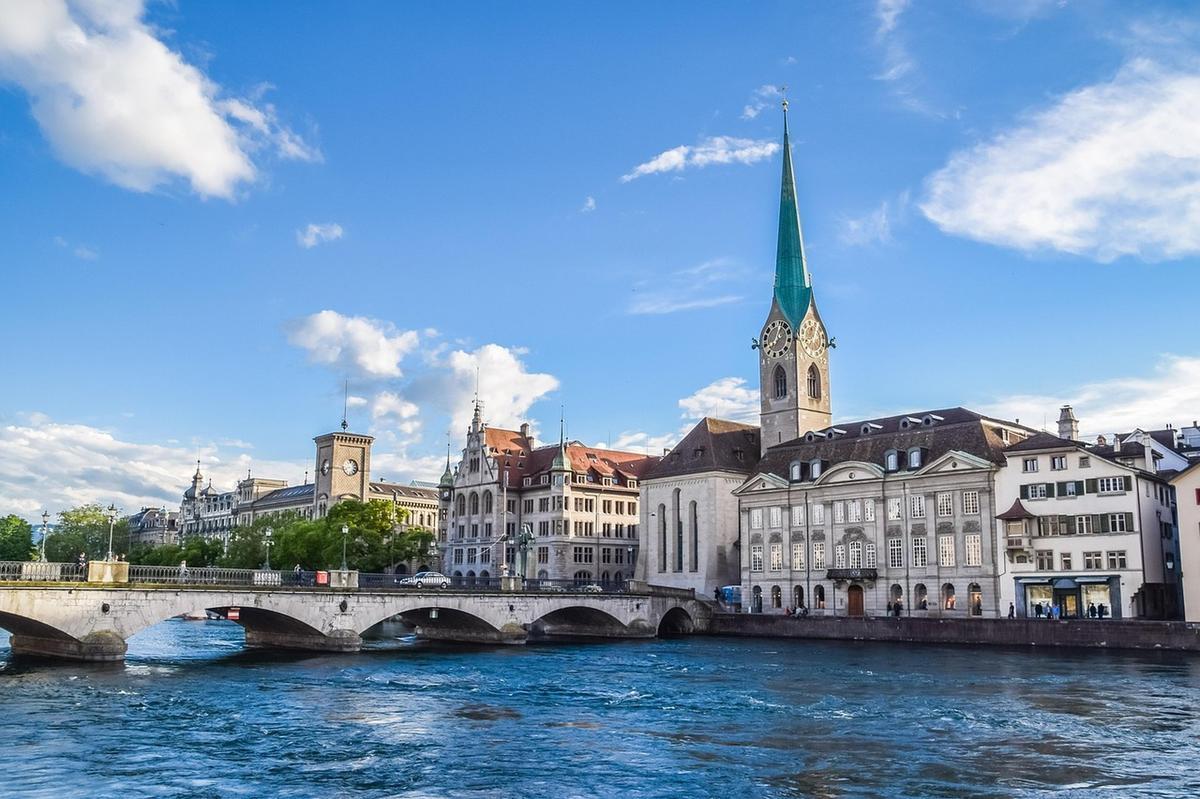
urich sits at the northwestern tip of its namesake lake in north-central Switzerland, a well-ordered city with some of Europe's cleanest air, safe streets, excellent public transit, and an international-school market substantial enough for most families. English carries further than the German signage suggests. The bill for all of it is real.
Draws high-earning professionals and senior expats for whom cost is secondary to quality: the city returns near-total safety, excellent walkability, first-rate public transit, and a well-stocked international-school bench. Healthcare-focused retirees comfortable in a cold, German-speaking environment find a place that functions without friction. Families weigh the schools and the Alpine weekends and rarely leave disappointed.
The constraint is singular and structural: Zurich is expensive in a way that rewrites budgets rather than nudges them, and that cost is the filter through which everything else must pass. The city's nightlife is measured by European standards, German dominates beyond the business district, and the winters are cold and slow.
Find cities that fit you
A free quiz ranks all 343 cities against what matters to you.
Vibe and character
Zurich runs on a composed, purposeful rhythm—trams precise, lakeside promenades quiet by eleven, dinner done before midnight. Weekends open quickly onto the Alps or across three nearby borders. The sensory register is ordered rather than electric; its satisfactions arrive as infrastructure, not spectacle.
Source: UNESCO · Methodology
City character
Our estimate: city character ratings · Methodology
Cost
Top-tier large-city cost — Zurich at $7,724 solo, among the priciest large cities across the cities we cover. Internal rental spread is moderate: a typical large-city ratio between prime and outside-of-centre rents, with the central premium pronounced but not extreme.
Source: Numbeo, collected November 2026, in our cost model · Methodology
These are recurring monthly costs. Moving itself — deposits, shipping, visas, flights, temporary accommodation — is not included, and it is usually the largest number in your first year. When grouped by region elsewhere on this site, North America covers the United States, Canada, and Mexico.
Monthly cost · by household
Priced for a Western-expat mid-range lifestyle — local-style living usually costs less.
All figures above are the Average lifestyle baseline for Zurich — Western mid-range expat methodology, November 2026, line-by-line cost model. Want to model a different lifestyle? Use the widget below to swap household size, lifestyle tier, and quick toggles. It starts from the same Solo + Average baseline and diverges as you customize.
Run the full Cost Reality Check for Zurich
Priced for your household and lifestyle tier, line by line. $79 one-time.
Where Zurich sits globally
Among the most expensive cities in the corpus.
Safety and rights
Zurich rates high on personal safety: 76 out of 100. The score reflects a uniform-safe profile rather than a concentrated risk pattern.
Sources: Numbeo, collected November 2026 · ILGA World · Georgetown GIWPS, 2023/24 · Freedom House · Methodology
Climate
Cold-oceanic climate — long winters that demand real winter clothing, summers that arrive late and leave early. Seasonal extremes stay in check by global standards — June is the wettest month and July the warmest.
Sources: WMO / NOAA NCEI, normals 1991–2020, published 2023, checked Oct 2026 · ACAG SatPM2.5 (Washington University in St. Louis), 2021–2023 · Methodology
Our estimate: winter rating · Methodology
12-month temperature and rainfall
July is the hottest month at 24°C average highs; June brings the year's heaviest rainfall at 128 mm.
Season by season
Coolest months · Dec–Feb
The coolest stretch of the year — average highs around 4°C.
Hottest months · Jun–Aug
The warmest stretch of the year — average highs around 24°C.
Wettest months · May–Jul
The heaviest rainfall of the year — about 128 mm in the wettest month.
Healthcare
The healthcare system in Zurich is excellent in absolute terms and universal in structure — the core system does the heavy lifting and private options compete on convenience and choice. English in clinical settings is good though not universal, and access runs through the country's health system.
Source: international insurers, 2024 · Methodology
Our estimate: healthcare quality and English-medium care · Methodology
A basic local insurance plan runs $152 a month.
Zurich's system is built on regulated insurers rather than a single state fund — residents choose an insurer, and the basic package is the same whichever they pick. Most expats rely on the mandatory basic policy for everyday care, with any supplementary plan bought separately from the basic package. International-portable cover generally does not replace the mandatory basic policy for residents — it is mainly useful as a supplement for care abroad.
Systems, insurance and prescription rules are set nationally, not city by city. How healthcare abroad actually works
The quiz weights healthcare quality against your other priorities — climate, cost, language — to show where Zurich stands. Get the full ranking · $99
Practical
Zurich runs at top-tier standard on getting around — transit and walking both working at the high end of the corpus. Public transit is strong — solid network coverage across the city with reliable service. Zurich's walkability is exceptional — pedestrian-priority street design at the city-block level supports walking as the primary mode. Tap water is drinkable across Zurich — household filtration is unnecessary for daily use.
Sources: OpenStreetMap contributors · EF EPI · Methodology
Our estimate: visa and admin, Western digital services · Methodology
Language
German is the main language of Zurich, though English proficiency in the country sits in the High band — sufficient for most daily expat needs. In practice, English works well for most daily expat needs — central commerce, hospitality, healthcare, and white-collar workplaces — with the limits showing up in residential and bureaucratic interactions. Investing in German matters for residential integration — short stays work in English alone, longer stays benefit from local-language competence.
Mobility and connectivity
Walking is the default mode in Zurich — at walkability 92, pedestrian-priority planning at the city-block level supports living almost entirely on foot. Public transit in Zurich is strong — a well-developed network covers the major districts reliably, with high frequency on core routes. Ride-hailing exists as a backup mode in Zurich but at $43 per typical trip, daily reliance is expensive — most residents lean on transit or private vehicle for routine movement.
Transit scores count only transit with its own dedicated right-of-way — metro, elevated and underground rail, trams on dedicated lines, and fully separated busways (BRT). Buses and trams sharing regular car lanes don’t count, however frequent.
Visa pathways and admin ratings shown here are for the principal applicant — spouse and dependant work rights vary by pathway; check the linked official source before relying on them.
Minority faith infrastructure
Mosques — moderate · Synagogues — few.
We record mosques, synagogues, Buddhist temples and Hindu temples — the ones hardest to assume from a country's majority religion — and show whichever are present here. Christian places of worship are not recorded; in most of the corpus they are the default rather than the question.
The quiz weights admin complexity against your situation to show where Zurich stands. Get the full ranking · $99
Schools
The international-school landscape in Zurich runs deep — 35 schools provide international curricula, of which 12 carry an IB programme, with capacity across curriculum types and price tiers. International tuition runs $40,546 a year on average — top-band pricing across the cities we cover, with the cost of school fees forming a substantial share of total family budget.
Our estimate: school counts · Methodology
Tuition: Estimated — no published price found.
Zurich's international-school market is one of the deeper in Western Europe — 35 schools serve the expat and long-stay community across the major curricula. Curriculum variety is substantial — the 35 schools include British, American, French, German, IB, and other major curricula, of which 12 carry an IB programme, providing depth across most family profiles. At $40,546 a year on average, Zurich's international tuition is top-tier across the cities we cover — the cost of school fees forming a substantial share of total family budget.
Below international schooling sits a robust bilingual tier in Zurich — German-English curricula at notably reduced tuition, suiting families on longer integration horizons. The international-school landscape in Zurich accommodates all major family profiles — the practical decision is usually fit-to-curriculum rather than whether options exist.
The quiz weights school availability against your other priorities — climate, cost, language, healthcare — to rank Zurich against other cities with comparable school depth. Compare the free and full quiz
Sources
- Numbeo, collected November 2026, in our cost model: monthly costs, cost rank
- WMO / NOAA NCEI, normals 1991–2020, published 2023, checked Oct 2026: climate type and temperatures, muggy months
- Numbeo, collected November 2026: safety index
- Freedom House: political freedom
- EF EPI: English proficiency
- UNESCO: World Heritage sites
- ILGA World: LGBTQ+ rights
- Georgetown GIWPS, 2023/24: women’s safety
- ACAG SatPM2.5 (Washington University in St. Louis), 2021–2023: air quality
- international insurers, 2024: health insurance
- OpenStreetMap contributors: walk and transit scores
Data last reviewed October 2026
The Zurich decision pack.
Includes Find My City (every city that clears your non-negotiables, ranked) and the Cost Reality Check for Zurich. One-time payment.
Similar to Zurich

Our estimate: food and weekend chips · Methodology
Find cities that fit you
A free quiz ranks all 343 cities against what matters to you.