South America · Ecuador
Guayaquil
Ecuador's commercial engine runs on the Guayas waterfront, where the money moves and the safety calculus shapes every neighbourhood choice.
Solo $2,138/mo · Couple $3,062/mo · Data as of November 2026
Our estimate: energy and cuisine · Methodology
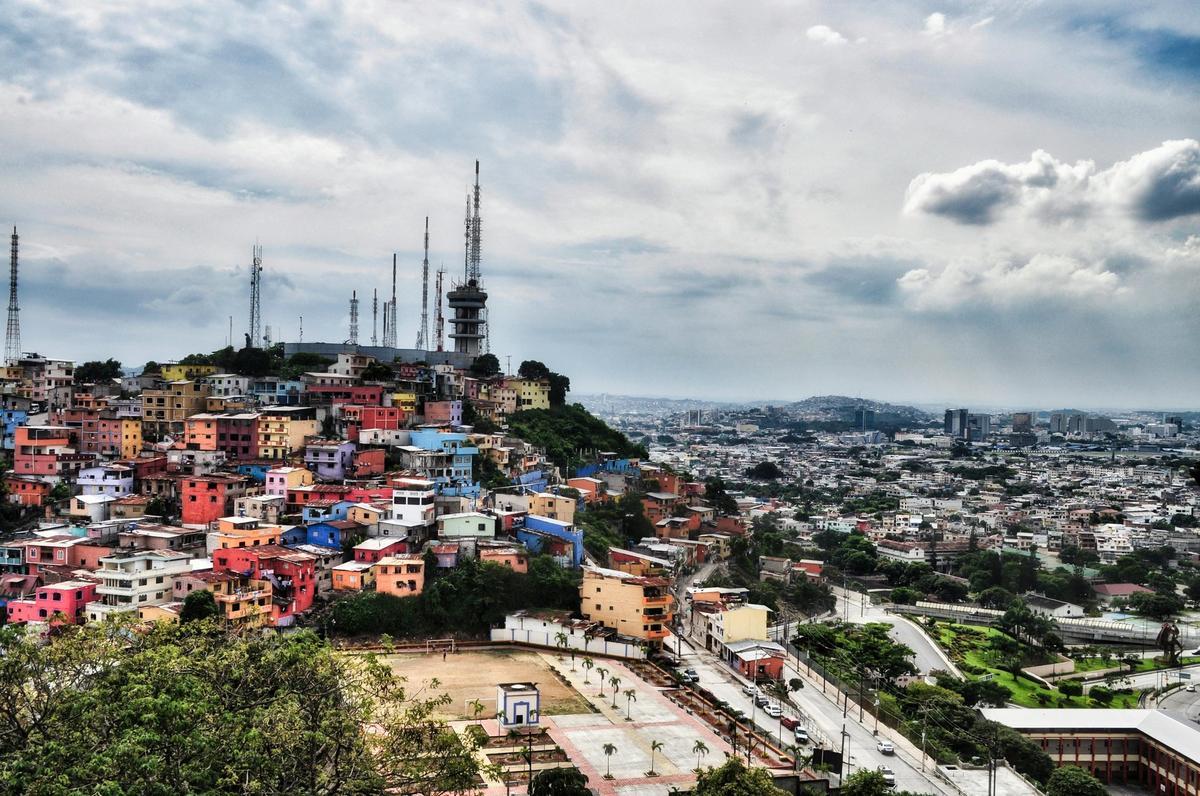
uayaquil spreads along the Guayas River where it nears the Gulf of Guayaquil, Ecuador's commercial capital and principal port rather than its political one. The city is affordable by South American standards for a metropolis this size, with good healthcare and a workable international-school market. The climate is tropical and relentlessly humid—no winter arrives, only a wet season and a dry one.
Guayaquil works for budget-conscious remote workers who want South American costs without giving up accessible healthcare. Families find a well-developed international curriculum market, with strong IB provision. Entrepreneurs plugged into Ecuador's commercial networks find the port-economy logic coherent and the cost base forgiving. Retirees seeking solid care at a fraction of Western prices have made a real foothold here.
Civil liberties are partial and unevenly protected; English carries limited reach, making Spanish fluency a practical requirement rather than a courtesy; and tap water must be treated before drinking. But the city's dominant constraint is safety—movement here is neighbourhood-dependent in ways that shape daily life structurally, demanding local knowledge and near-total car reliance.
Find cities that fit you
A free quiz ranks all 343 cities against what matters to you.
Vibe and character
Guayaquil runs hot and late—the food is spiced and layered, the nights carry their own logic, and the wider region opens easily via short-haul connections. The sensory register is dense and forward: heavy air, market noise, the particular energy of a city that takes no cues from restraint.
Source: UNESCO · Methodology
City character
Our estimate: city character ratings · Methodology
Cost
At $2,138 solo, Guayaquil sits in the lower-cost band of global large cities — a meaningful cost advantage for the scale of city. Rental spread is tight: Guayaquil's prime and outside-of-centre rents differ by less than the typical large-city ratio, limiting the budget flexibility a relocation move can exploit.
Source: Numbeo, collected November 2026, in our cost model · Methodology
These are recurring monthly costs. Moving itself — deposits, shipping, visas, flights, temporary accommodation — is not included, and it is usually the largest number in your first year. When grouped by region elsewhere on this site, North America covers the United States, Canada, and Mexico.
Monthly cost · by household
Priced for a Western-expat mid-range lifestyle — local-style living usually costs less.
All figures above are the Average lifestyle baseline for Guayaquil — Western mid-range expat methodology, November 2026, line-by-line cost model. Want to model a different lifestyle? Use the widget below to swap household size, lifestyle tier, and quick toggles. It starts from the same Solo + Average baseline and diverges as you customize.
Run the full Cost Reality Check for Guayaquil
Priced for your household and lifestyle tier, line by line. $79 one-time.
Where Guayaquil sits globally
Cost-of-living runs at the low end of the corpus.
Safety and rights
UK FCDO advises against all but essential travel to Guayas province, updated 1 Nov 2026. The crime figures below describe everyday street crime in normal conditions and do not capture the risk behind that warning.
UK FCDO advises against all but essential travel to Guayas province, updated 1 Nov 2026.
Sources: Numbeo, collected November 2026 · UK FCDO, read November 2026 · ILGA World · Georgetown GIWPS, 2023/24 · Freedom House · Methodology
Climate
Year-round warmth defines Guayaquil — a tropical-savanna pattern with average highs that stay between roughly 29°C and 32°C, and no winter that earns the name. The year divides into wet and dry — rainfall peaks around February (332mm), while the driest months see far less. Humidity sits very high year-round — air conditioning is operational infrastructure, not a comfort upgrade, and outdoor exertion stays heat-limited across most of the calendar.
Sources: INAMHI, normals 1981–2010, checked Oct 2026 · Copernicus Climate Change Service (ERA5), dataset cited 2023, means for 1991–2020, checked Oct 2026 · ACAG SatPM2.5 (Washington University in St. Louis), 2021–2023 · Methodology
Our estimate: winter rating · Methodology
12-month temperature and rainfall
March is the hottest month at 32°C average highs; February brings the year's heaviest rainfall at 332 mm.
Sunshine hours: not available for this city
Season by season
Coolest months · Jun–Aug
The coolest stretch of the year — average highs around 29°C.
Hottest months · Mar · Apr · Dec
Peak heat — average highs around 32°C. Outdoor activity tends to shift to mornings and evenings.
Wettest months · Feb–Apr
The heaviest rainfall of the year — about 332 mm in the wettest month.
Healthcare
The healthcare picture in Guayaquil is solid — quality is good for routine medicine, and residency status and insurance shape which facilities expats use. English in healthcare runs moderate — workable at the top, sparser below, and the country's health system sets how care is organised.
Source: international insurers, 2024 · Methodology
Our estimate: healthcare quality and English-medium care · Methodology
Healthcare costs are mid-band — local insurance at $152 a month, with procedure pricing below US private-market rates though above the cheapest emerging markets.
The public system runs in parallel. Ecuador citizens are covered through a national scheme; foreign residents can access government hospitals on a fee-for-service basis, but most long-stayers don't. Most long-stay expats rely on private medicine — the public layer is functional but not the default choice for those with private cover. Portable international cover runs at a fraction of US, UK, or Western European pricing — competitive options for the holder wanting global access.
Systems, insurance and prescription rules are set nationally, not city by city. How healthcare abroad actually works
The quiz weights healthcare quality against your other priorities — climate, cost, language — to show where Guayaquil stands. Get the full ranking · $99
Practical
Getting around Guayaquil carries meaningful friction — walking and transit both score low, with the practical effect being constant low-level logistics work. Guayaquil's transit network is thin — bus and limited rail coverage means most residents rely on cars or ride-hail for everyday movement. Walking is a constrained mode. Tap water is not generally drunk straight from the tap — filtration systems or bottled water are the daily practice across Guayaquil.
Sources: OpenStreetMap contributors · EF EPI · Methodology
Our estimate: visa and admin, Western digital services · Methodology
Language
The main language of Guayaquil is Spanish, and the EF Index rates the population in the Low band on English — how far English carries depends heavily on the neighbourhood and the service. Practical English in Guayaquil varies by setting — dependable at the obvious expat-facing layers, much less predictable beyond them. For stays over a year, Spanish study pays back — even where English covers the essentials, the local language opens up more of Guayaquil.
Mobility and connectivity
Walking works in Guayaquil's central districts but becomes impractical at the city scale — the 40 score reflects connectivity gaps and physical separations between zones. Public transit in Guayaquil is limited — central routes work, but the broader network is patchy. Ride-hail pricing in Guayaquil is moderate — at average $9, regular use is comfortable for higher-income expats but accumulates for budget-sensitive ones.
Transit scores count only transit with its own dedicated right-of-way — metro, elevated and underground rail, trams on dedicated lines, and fully separated busways (BRT). Buses and trams sharing regular car lanes don’t count, however frequent.
Visa pathways and admin ratings shown here are for the principal applicant — spouse and dependant work rights vary by pathway; check the linked official source before relying on them.
Minority faith infrastructure
Mosques — moderate · Synagogues — few.
We record mosques, synagogues, Buddhist temples and Hindu temples — the ones hardest to assume from a country's majority religion — and show whichever are present here. Christian places of worship are not recorded; in most of the corpus they are the default rather than the question.
The quiz weights admin complexity against your situation to show where Guayaquil stands. Get the full ranking · $99
Schools
International schooling in Guayaquil is well-developed but not deep — 20 schools run international curricula, of which 16 carry an IB programme, with the practical constraint usually budget rather than availability. Tuition averages $9,173 a year — below most Western European or US benchmarks, with the cost spread covering both established institutions and mid-market alternatives.
Our estimate: school counts · Methodology
Tuition: Estimated — no published price found.
The international-school sector in Guayaquil is solidly developed — 20 schools cover the typical expat needs with capacity and curriculum range comparable to peer South American cities. The 20 international-curriculum schools in Guayaquil include British, American, French, German, and other major curricula, of which 16 carry an IB programme, providing solid coverage for most expat family profiles. Tuition averages $9,173 a year across the system, with the spread covering premium institutions at multiples above and mid-market alternatives below the mean.
Beneath the international layer, Guayaquil carries an established bilingual school sector — Spanish-English programmes at meaningfully lower tuition than full international schools. Guayaquil's school market accommodates most expat family profiles comfortably — the limiting factor is typically tuition tier or specific curriculum requirements, rather than capacity.
The quiz weights school availability against your other priorities — climate, cost, language, healthcare — to rank Guayaquil against other cities with comparable school depth. Compare the free and full quiz
Sources
- Numbeo, collected November 2026, in our cost model: monthly costs, cost rank
- INAMHI, normals 1981–2010, checked Oct 2026: climate type and temperatures
- Numbeo, collected November 2026: safety index
- Freedom House: political freedom
- EF EPI: English proficiency
- UNESCO: World Heritage sites
- UK FCDO, read November 2026: travel warning
- ILGA World: LGBTQ+ rights
- Georgetown GIWPS, 2023/24: women’s safety
- Copernicus Climate Change Service (ERA5), dataset cited 2023, means for 1991–2020, checked Oct 2026: muggy months
- ACAG SatPM2.5 (Washington University in St. Louis), 2021–2023: air quality
- international insurers, 2024: health insurance
- OpenStreetMap contributors: walk and transit scores
Data last reviewed October 2026
The Guayaquil decision pack.
Includes Find My City (every city that clears your non-negotiables, ranked) and the Cost Reality Check for Guayaquil. One-time payment.
Similar to Guayaquil

Our estimate: food and weekend chips · Methodology
Find cities that fit you
A free quiz ranks all 343 cities against what matters to you.