North America · United States
Honolulu
A mid-Pacific US capital with a beach commute and island prices, where the mainland is a long flight away.
Solo $7,475/mo · Couple $10,746/mo · Data as of November 2026
Our estimate: energy and cuisine · Methodology
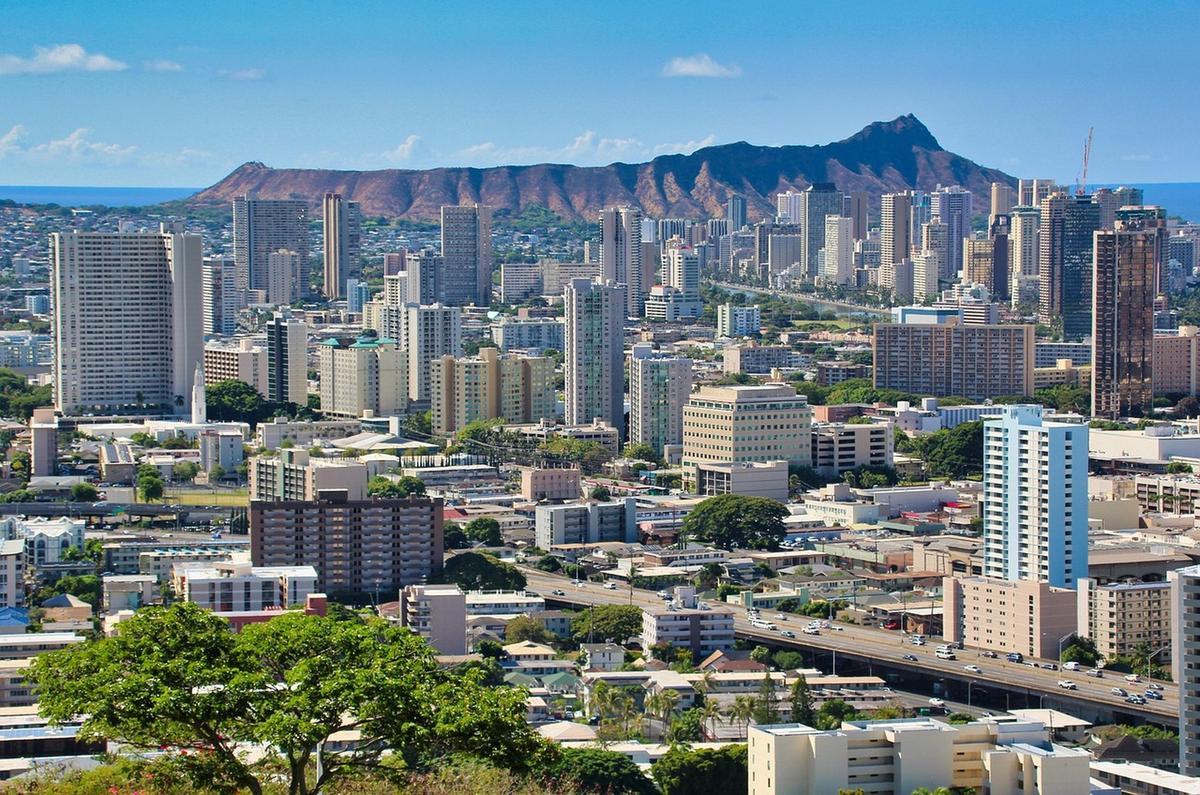
onolulu sits on the southern shore of Oʻahu, a U.S. state capital floating in the Pacific with year-round warmth, clean air, and English as the only language you will ever need. Healthcare here is excellent, water comes clean from the tap, and the civil landscape is fully open. The cost of living runs high.
Honolulu suits healthcare-focused retirees who want warm winters without the medical uncertainty of moving abroad, and remote workers whose income arrives in dollars and can absorb the premium. Families with school-age children find an international-curriculum market that is workable if limited. Surfers, ocean athletes, and anyone whose leisure life centres on water will find the physical setting exceptional.
But the island's isolation is structural: short-haul escapes are expensive and limited, and the city is built almost entirely around the car—transit covers so little of daily life that it barely registers as an option. The cost of living at this latitude, on this island, in this country, is demanding.
Find cities that fit you
A free quiz ranks all 343 cities against what matters to you.
Vibe and character
Honolulu moves with the ease of a city that has never needed to sell itself—warm evenings, terrace dining drawn from across the Pacific, a nightlife that winds down at a reasonable hour. Weekends turn residents toward the island's interior and coastlines rather than any border crossing; the horizon is always water.
City character
Our estimate: city character ratings · Methodology
Cost
$7,475 for a solo month puts Honolulu in the top tier of large-city cost — among the most expensive in the corpus for its scale. The cost ladder within Honolulu has the expected shape — prime areas command a premium over outer districts, though not at the extremes seen in cities with very high inequality.
Source: Numbeo, collected November 2026, in our cost model · Methodology
These are recurring monthly costs. Moving itself — deposits, shipping, visas, flights, temporary accommodation — is not included, and it is usually the largest number in your first year. When grouped by region elsewhere on this site, North America covers the United States, Canada, and Mexico.
Monthly cost · by household
Priced for a Western-expat mid-range lifestyle — local-style living usually costs less.
All figures above are the Average lifestyle baseline for Honolulu — Western mid-range expat methodology, November 2026, line-by-line cost model. Want to model a different lifestyle? Use the widget below to swap household size, lifestyle tier, and quick toggles. It starts from the same Solo + Average baseline and diverges as you customize.
Run the full Cost Reality Check for Honolulu
Priced for your household and lifestyle tier, line by line. $79 one-time.
Where Honolulu sits globally
Sits in the top cost band of the corpus.
Safety and rights
On personal safety Honolulu sits in the moderate band at 53, with a consistent profile across the city — the caution this score implies applies about equally everywhere, not just after dark or in one part of town.
Sources: Numbeo, collected November 2026 · ILGA World · Georgetown GIWPS, 2023/24 · Freedom House · Methodology
Climate
Honolulu sits in a hot semi-arid climate with no real winter — average highs run from around 27°C in the coolest month to 32°C in August. Rain is the scarce part — March is the wettest month, and the driest months see very little.
Sources: WMO / NOAA NCEI, normals 1991–2020, published 2023, checked Oct 2026 · National meteorological services, checked Oct 2026 · ACAG SatPM2.5 (Washington University in St. Louis), 2021–2023 · Methodology
Our estimate: winter rating · Methodology
12-month temperature and rainfall
August runs hottest (32°C average highs); March brings the heaviest rain (60 mm).
Sunshine hours: not available for this city
Season by season
Coolest months · Jan–Mar
The coolest stretch of the year — average highs around 27°C.
Hottest months · Jul–Sep
Peak heat — average highs around 32°C. Outdoor activity tends to shift to mornings and evenings.
Wettest months · Mar · Nov · Dec
The heaviest rainfall of the year — about 60 mm in the wettest month.
Healthcare
Honolulu's healthcare reads as excellent — specialist depth is strong, and how expats access it depends mainly on their insurance. English in clinical settings is reliably excellent, and care is organised through the country's health system.
Source: international insurers, 2024 · Methodology
Our estimate: healthcare quality and English-medium care · Methodology
Top-tier costs apply — local insurance at $568 a month, and out-of-pocket pricing tracks closely with US or Northern European private rates.
Public programmes in Honolulu target specific groups — such as older or lower-income residents, or citizens — rather than automatically covering every foreign resident, so most expats get cover through an employer or a private policy. Before arrival, check what an employer plan covers — deductibles, co-payments and provider networks vary widely between policies. International cover is most useful here for frequent travellers and for care abroad — for treatment at home, local employer or private plans are the usual route.
Systems, insurance and prescription rules are set nationally, not city by city. How healthcare abroad actually works
The quiz weights healthcare quality against your other priorities — climate, cost, language — to show where Honolulu stands. Get the full ranking · $99
Practical
Honolulu's mobility has substantive gaps — walking and transit are both limited, and the gaps combine into daily friction. Honolulu's transit network is minimal — most residents own cars or rely on ride-hail for daily movement. Honolulu's walkability is limited — distances, traffic, and separation between districts constrain pedestrian use. Tap water is drinkable across Honolulu — household filtration is unnecessary for daily use.
Sources: OpenStreetMap contributors · EF EPI · Methodology
Our estimate: visa and admin, Western digital services · Methodology
Language
The working language of Honolulu is English — primary across business, government, and daily life with native-level prevalence. English is the working language across every institutional and daily layer of Honolulu.
Mobility and connectivity
Walkability in Honolulu is limited — at a walkability estimate of 40, daily distances usually exceed pedestrian range and infrastructure thins quickly outside central districts. Honolulu's public transport is minimal — a small bus network and limited or absent rail mean transit-only living isn't viable for most expats. Ride-hail prices in Honolulu run high — at $20 per typical trip, the mode is workable for occasional use but accumulates fast for daily reliance.
Transit scores count only transit with its own dedicated right-of-way — metro, elevated and underground rail, trams on dedicated lines, and fully separated busways (BRT). Buses and trams sharing regular car lanes don’t count, however frequent.
Visa pathways and admin ratings shown here are for the principal applicant — spouse and dependant work rights vary by pathway; check the linked official source before relying on them.
Minority faith infrastructure
Mosques — few · Synagogues — few · Buddhist temples — many · Hindu temples — few.
We record mosques, synagogues, Buddhist temples and Hindu temples — the ones hardest to assume from a country's majority religion — and show whichever are present here. Christian places of worship are not recorded; in most of the corpus they are the default rather than the question.
The quiz weights admin complexity against your situation to show where Honolulu stands. Get the full ranking · $99
Schools
Honolulu offers English-medium public schooling, supplemented by 10 international-curriculum schools, of which 9 carry an IB programme for non-state options. Tuition averages $27,951 a year — sits in the premium band of expat-school pricing, with the practical cost of family relocation factoring tuition heavily into total household budgets.
Our estimate: school counts · Methodology
Tuition: Estimated — no published price found.
International schooling in Honolulu is moderately developed — 10 schools cover specific international curriculum needs, with a mix of providers serving the expat community. Honolulu's 10 international-curriculum schools cover the major Anglosphere, Continental-European, and IB curricula, of which 9 carry an IB programme, with reasonable curriculum range for typical expat needs. International tuition runs $27,951 a year on average — premium-tier by global standards, with fees varying widely between schools.
Below the international tier sits the public school system, which includes English-medium schools — eligibility and admission rules for newcomers are worth checking early. Most expat families find a workable fit in Honolulu — the question is usually budget calibration and curriculum match rather than absence of options.
The quiz weights school availability against your other priorities — climate, cost, language, healthcare — to rank Honolulu against other cities with comparable school depth. Compare the free and full quiz
Sources
- Numbeo, collected November 2026, in our cost model: monthly costs, cost rank
- WMO / NOAA NCEI, normals 1991–2020, published 2023, checked Oct 2026: climate type and temperatures
- Numbeo, collected November 2026: safety index
- Freedom House: political freedom
- EF EPI: English proficiency
- ILGA World: LGBTQ+ rights
- Georgetown GIWPS, 2023/24: women’s safety
- National meteorological services, checked Oct 2026: muggy months
- ACAG SatPM2.5 (Washington University in St. Louis), 2021–2023: air quality
- international insurers, 2024: health insurance
- OpenStreetMap contributors: walk and transit scores
Data last reviewed October 2026
The Honolulu decision pack.
Includes Find My City (every city that clears your non-negotiables, ranked) and the Cost Reality Check for Honolulu. One-time payment.
Similar to Honolulu





Our estimate: food and weekend chips · Methodology
Find cities that fit you
A free quiz ranks all 343 cities against what matters to you.