Africa · South Africa
Johannesburg
Africa's wealthiest city built its fortune in the ground and its daily life around the compound wall.
Solo $2,389/mo · Couple $3,569/mo · Data as of November 2026
Our estimate: energy and cuisine · Methodology
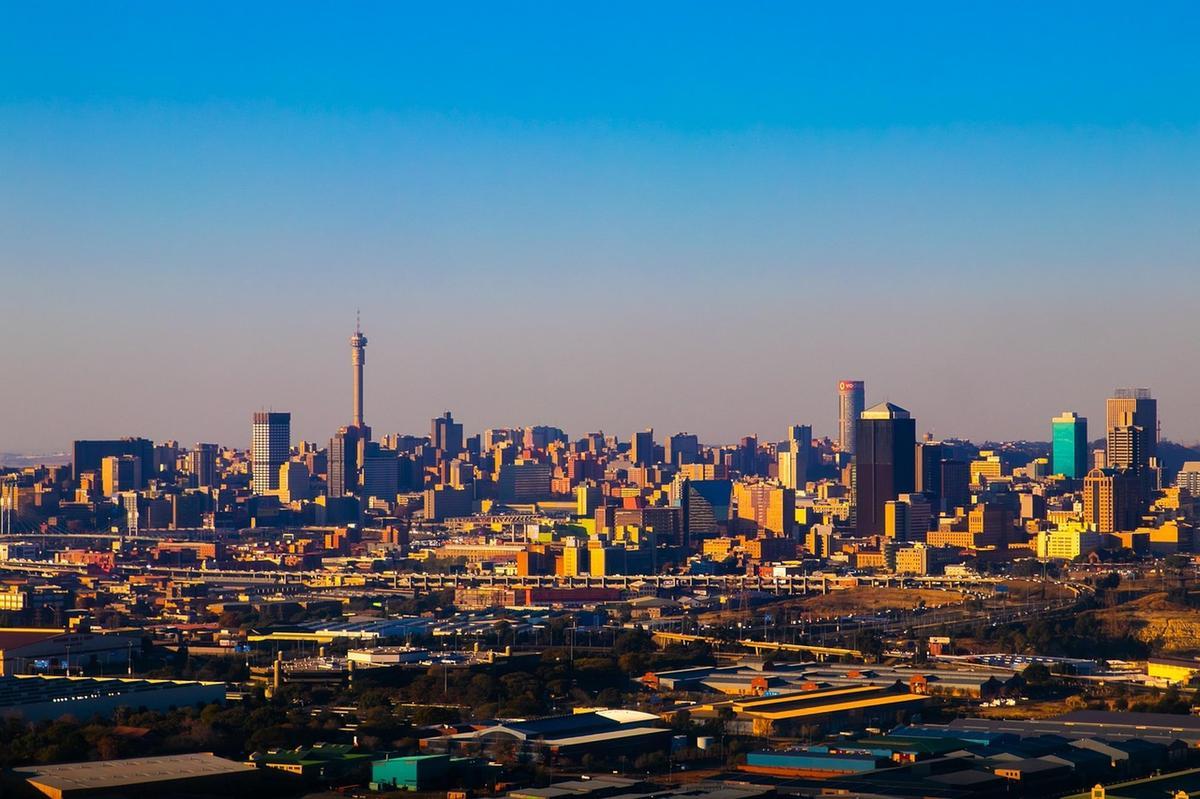
ohannesburg spreads across the mineral-rich Witwatersrand hills as Africa's wealthiest city and the continent's financial centre, a megacity that stays cheap relative to its economic weight. English is the language of business and daily life; healthcare is solid. The city's organizing fact—safety, which is acutely neighbourhood-dependent—arrives alongside everything else.
Johannesburg suits entrepreneurs and finance professionals drawn to the continent's largest stock exchange and its surrounding infrastructure. Remote workers willing to engage the security trade-offs find real value: solid healthcare and living costs that represent a meaningful discount for a city of this economic weight. An established international school market is in place.
Safety is not an abstraction here—it is a daily choreography of gated neighbourhoods, private transport, and streets that do not get walked. There is almost no public transit, making car dependency total. Tap water needs filtering, and the distance between expat Johannesburg and the wider city is wide enough to function as two separate places.
Find cities that fit you
A free quiz ranks all 343 cities against what matters to you.
Vibe and character
Johannesburg conducts its energy indoors and after dark—terrace dinners running past midnight, a food scene drawing on a mixed culinary tradition, neighbourhood bars that never quite wind down. Weekend escapes within the immediate region are limited, but the short-haul network opens southern Africa.
Source: UNESCO · Methodology
City character
Our estimate: city character ratings · Methodology
Cost
Megacity-scale at low-band cost — Johannesburg runs $2,389 for a solo month, below most peer megacities. Housing costs spread moderately across Johannesburg — the central premium is real, and moving outward offers meaningful but not dramatic savings.
Source: Numbeo, collected November 2026, in our cost model · Methodology
These are recurring monthly costs. Moving itself — deposits, shipping, visas, flights, temporary accommodation — is not included, and it is usually the largest number in your first year. When grouped by region elsewhere on this site, North America covers the United States, Canada, and Mexico.
Monthly cost · by household
Priced for a Western-expat mid-range lifestyle — local-style living usually costs less.
All figures above are the Average lifestyle baseline for Johannesburg — Western mid-range expat methodology, November 2026, line-by-line cost model. Want to model a different lifestyle? Use the widget below to swap household size, lifestyle tier, and quick toggles. It starts from the same Solo + Average baseline and diverges as you customize.
Run the full Cost Reality Check for Johannesburg
Priced for your household and lifestyle tier, line by line. $79 one-time.
Where Johannesburg sits globally
Lifestyle costs sit firmly in the lower band of the corpus.
Safety and rights
Johannesburg reads at 19 on safety. The neighbourhood-dependent profile means the citywide score understates the safest districts and overstates the safest hours.
Sources: Numbeo, collected November 2026 · ILGA World · Georgetown GIWPS, 2023/24 · Freedom House · Methodology
Climate
Johannesburg sits in a subtropical highland climate with a mild winter — altitude keeps the year temperate, with average highs between about 16°C and 24°C, a dry winter and most of the rain in the warmer half of the year. The year carries a highland rhythm — wetter months centred on December alternate with drier, brighter ones, with altitude keeping daytime temperatures mild year-round.
Sources: CHELSA, 2021, normals 1991–2020, modelled estimate, checked Oct 2026 · Copernicus Climate Change Service (ERA5), dataset cited 2023, means for 1991–2020, checked Oct 2026 · ACAG SatPM2.5 (Washington University in St. Louis), 2021–2023 · Methodology
Our estimate: winter rating · Methodology
12-month temperature and rainfall
October is the hottest month at 24°C average highs; December brings the year's heaviest rainfall at 157 mm.
Sunshine hours: not available for this city
Season by season
Coolest months · May–Jul
The coolest stretch of the year — average highs around 16°C.
Hottest months · Jan · Oct · Dec
The warmest stretch of the year — average highs around 24°C.
Wettest months · Dec–Feb
The heaviest rainfall of the year — about 157 mm in the wettest month.
Healthcare
Johannesburg carries good healthcare for daily medicine — the typical expat caseload is handled locally, with referrals to specialist centres when needed. English-language care is available in the larger private facilities, and access runs through the country's health system.
Source: international insurers, 2024 · Methodology
Our estimate: healthcare quality and English-medium care · Methodology
Healthcare costs are mid-band — local insurance at $152 a month, with procedure pricing below US private-market rates though above the cheapest emerging markets.
The public sector in Johannesburg serves South Africa citizens and registered foreign residents — quality varies by facility, and the practical expat pattern is private medicine for routine care. Most long-stay expats rely on private medicine — the public layer is functional but not the default choice for those with private cover. International-portable cover with global access is widely available and well-priced — typically a fraction of comparable US plans, with the affordability making it standard among long-stayers.
Systems, insurance and prescription rules are set nationally, not city by city. How healthcare abroad actually works
The quiz weights healthcare quality against your other priorities — climate, cost, language — to show where Johannesburg stands. Get the full ranking · $99
Practical
Getting around Johannesburg on foot or by transit sits below the corpus's stronger cities — daily trips need workarounds rather than happening effortlessly. Transit is constrained in Johannesburg — limited routes mean public-transport-only living is impractical for most expats. Walking in Johannesburg is constrained — sidewalks, traffic, and district separation combine to make pedestrian living impractical for most. Tap water is not routinely drunk straight — most households rely on bottled or filtered supply.
Sources: OpenStreetMap contributors · EF EPI · Methodology
Our estimate: visa and admin, Western digital services · Methodology
Language
Zulu is the main language of daily life in Johannesburg, but English is in wide use — English speakers manage most practical situations, while Zulu opens up the rest. Day-to-day life in Johannesburg is manageable in English for most newcomers, while Zulu opens up more of the city's community and civic life. Picking up Zulu matters for community integration but not for daily logistics — English alone is functionally complete.
Mobility and connectivity
Johannesburg's walkability is limited — a walkability estimate of 30 reflects an urban form built around vehicles, with pedestrian infrastructure varying sharply by neighbourhood. Transit at 42 covers Johannesburg's central spine but thins quickly at the periphery — most residents combine transit with ride-hail or private vehicle. Ride-hailing is broadly available in Johannesburg at mid-band prices — typical trips around $8, with the cost being noticeable but not prohibitive.
Transit scores count only transit with its own dedicated right-of-way — metro, elevated and underground rail, trams on dedicated lines, and fully separated busways (BRT). Buses and trams sharing regular car lanes don’t count, however frequent.
Visa pathways
South Africa offers three long-stay routes: the Remote Work Visa for established foreign-income earners—relatively new and without a direct residency pathway—the Retired Person Visa for those on passive income, which does lead to permanent residency, and the Critical Skills Work Visa, open to professionals in listed occupations without requiring employer sponsorship. Details shift; confirm with the consulate.
Visa pathways and admin ratings shown here are for the principal applicant — spouse and dependant work rights vary by pathway; check the linked official source before relying on them.
Minority faith infrastructure
Mosques — many · Synagogues — moderate · Buddhist temples — few · Hindu temples — many.
We record mosques, synagogues, Buddhist temples and Hindu temples — the ones hardest to assume from a country's majority religion — and show whichever are present here. Christian places of worship are not recorded; in most of the corpus they are the default rather than the question.
The quiz weights admin complexity against your situation to show where Johannesburg stands. Get the full ranking · $99
Schools
International schooling in Johannesburg is deep — 35 schools run international curricula, with one offering an IB programme, with British, American, and Continental-European providers across the price band. International tuition runs $7,513 a year on average — comfortably below US or Western European private-school pricing, with the typical case in the low-to-mid band across the cities we cover.
Our estimate: school counts · Methodology
Tuition: Estimated — no published price found.
Johannesburg's international-school market is one of the deeper in Africa — 35 schools across British, American, French, and IB curricula serve the expat and long-stay community. Johannesburg's 35 international-curriculum schools cover the full range of expat needs — British, American, IB, French, German, and other curricula, with one offering an IB programme with strong representation across price tiers. At $7,513 a year on average, Johannesburg's international tuition runs comfortably below US or Western European private-school pricing, with the typical case in the low-to-mid band across the cities we cover.
Beneath international schooling, Johannesburg's options are fragmented — local private schools and state schools cover the rest of the market with variable quality and a language of instruction that differs by school. Most family profiles find a fit comfortably in Johannesburg — the deep market means trade-offs are about price-curriculum-location optimization rather than absence of options.
The quiz weights school availability against your other priorities — climate, cost, language, healthcare — to rank Johannesburg against other cities with comparable school depth. Compare the free and full quiz
Sources
- Numbeo, collected November 2026, in our cost model: monthly costs, cost rank
- CHELSA, 2021, normals 1991–2020, modelled estimate, checked Oct 2026: climate type and temperatures
- Numbeo, collected November 2026: safety index
- Freedom House: political freedom
- EF EPI: English proficiency
- UNESCO: World Heritage sites
- ILGA World: LGBTQ+ rights
- Georgetown GIWPS, 2023/24: women’s safety
- Copernicus Climate Change Service (ERA5), dataset cited 2023, means for 1991–2020, checked Oct 2026: muggy months
- ACAG SatPM2.5 (Washington University in St. Louis), 2021–2023: air quality
- international insurers, 2024: health insurance
- OpenStreetMap contributors: walk and transit scores
Data last reviewed October 2026
The Johannesburg decision pack.
Includes Find My City (every city that clears your non-negotiables, ranked) and the Cost Reality Check for Johannesburg. One-time payment.
Similar to Johannesburg
Our estimate: food and weekend chips · Methodology
Find cities that fit you
A free quiz ranks all 343 cities against what matters to you.